

Cat6 or Cat6A in the company: where is the decision threshold?
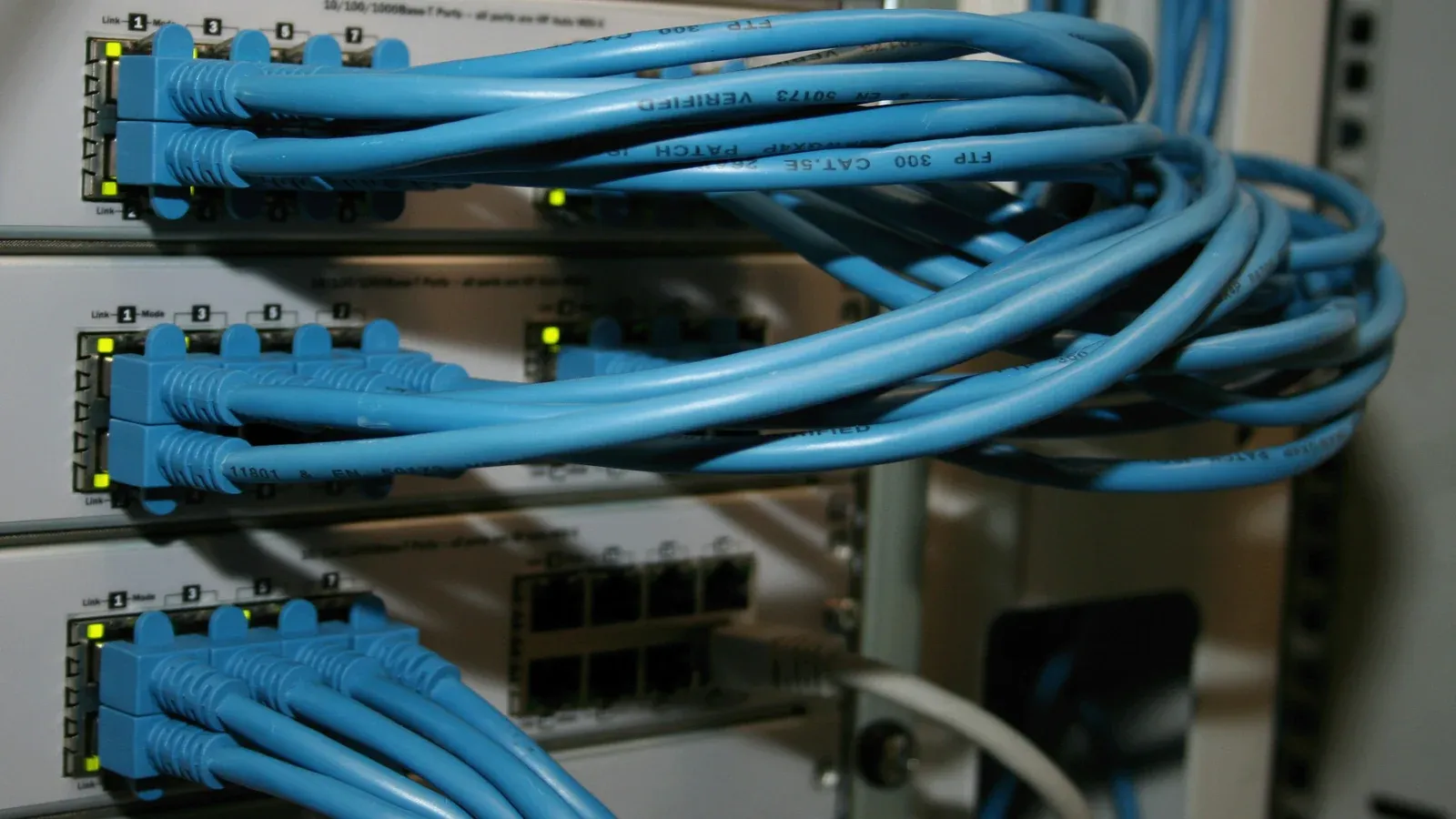
Cat6 or Cat6A is a decision about a spare for several years, not about which cable is better. This article shows where the real threshold is between them, why the cable itself is not the entire track and when the price difference is not worth it.
This is a decision for several years
Structured cabling is the most durable element of the IT infrastructure in a company, because computers are replaced every few years, switches every few to a dozen years, and the cables remain in the walls as long as the building is standing or the arrangement is in progress.
This creates an asymmetry that should drive the entire decision: the material is cheap, but the labour and wall closure are not, so the difference in cable price between categories is usually small considering the cost of re-forging, routing and restoring the finish.
Therefore, the question is not "what is enough today", but "what will be missing in ten years and how much the fix will cost" when the current routes are closed.
How do they differ in practice?
Both categories support typical office applications without a noticeable difference, which only becomes apparent at the highest throughput over the full distance.
Cat6 can handle demanding applications on shorter track and under favourable installation conditions, while full length is a lower throughput category.
Cat6A has been designed with greater headroom for high throughput over the full length of the horizontal track, thus maintaining performance under typical installation conditions, limiting the impact of extraneous crosstalk.
The key phenomenon behind this difference is alien crosstalk, i.e. interference transferred between adjacent cables arranged in a bundle. At high bandwidth, this becomes a more important limitation than interference within the cable itself, so Cat6A is designed with this limitation in mind, which translates into a larger diameter and stiffness.
This has direct mounting consequences, because a thicker cable means larger bending rays, fewer cables in the same trough and more work at the end.
The cable itself is not the entire track
This is where the most common misunderstanding regarding category selection occurs.
The transmission path includes cable, socket, patch panel and patch cables on both sides, which means that its category is determined by its weakest element.
Cat6A routed to a Cat6 socket, terminated on a Cat6 panel and connected with a random patch cable does not create a Cat6A installation, but becomes a more expensive cable in a lower-spec track.
This has two practical consequences:
- the category decision applies to the entire set of equipment, not just the cable. This changes the cost calculation more than the difference in the price of the cable itself,
- the quality of workmanship weighs as much as the category. Opening up the pair twist at the end, a bend that's too sharp, or a route along the power supply can ruin the performance regardless of what you buy.
This is also why for higher categories it is worth considering certification measurement, because without it there is no proof that the track actually meets the parameters for which it was paid. The distinction between a continuity test and a certification measurement is described in the article about network reception protocol.
When Cat6 is enough
Contrary to what the "let's get better" logic suggests, Cat6 remains a rational choice in many companies:
- typical office workstations: computers, telephones, printers,
- Internet connection and devices do not require bandwidth beyond basic office applications,
- no servers and arrays to which users access large files,
- standard distances, without extremely long tracks,
- a building where re-routing cable is feasible, for example with a suspended ceiling and accessible trays.
This last point is important, although it is often overlooked because if routes are available, the cost of changing later is moderate, making the decision to use Cat6 less risky. If, however, the cable runs in a chase under the plaster, the opposite is true.
When Cat6A makes sense
- to Wi-Fi access points. Newer generation points may require more bandwidth on the wired side, so this is where the spare comes in handy especially quickly,
- to server rooms and between distribution points, where traffic is aggregated,
- when working with large files: design, video, imaging, CAD,
- for long tracks close to the distance limit,
- in high density bundles, where alien crosstalk is a real problem,
- wherever the cable goes under the plaster and later modification means forging.
A practical approach that works for most companies assumes not one category for the entire object, but a division: Cat6A where likely to be useful and where a fix would be expensive, and Cat6 for typical sites in places with accessible routes.
PoE changes the calculus
PoE is an element that is sometimes omitted in this decision, although its importance increases with the number of powered devices.
Today, network cables power access points, cameras, telephones and more and more devices, and the flow of current causes heating of the cable, which deteriorates transmission parameters. The phenomenon intensifies in bundles, where heat from adjacent cables has no way to escape.
This is not a decisive argument in itself, but it changes the way you think about installation because with a larger number of devices powered by cable, it is worth talking not only about the category, but also about the method of routing and the size of the bundles.
The issue of power supply is described in more detail in the material o PoE in the corporate network and power budget.
What you don't buy when you buy a higher category
It is worth being candid here, because this is where it is easy to be disappointed:
- higher category does not speed up the Internet. The bandwidth of the operator's link is a separate limitation,
- does not accelerate devices. A computer with a lower bandwidth port will not start running faster after using Cat6A,
- does not fix bad workmanship. A poorly finished Cat6A track will perform worse than a well-finished Cat6 track,
- is not needed "just in case" everywhere. If the routes are available and the stands are typical, this is an expense with no effect.
Cat6 or Cat6A: how to make this decision
- Check that the cable will be accessible after the work is completed. If so, the risk of the lower category decreases.
- Mark the points where access points, cameras and cable-powered devices will go.
- Determine whether your company works on large files from a network resource.
- Check track lengths, especially to the farthest rooms.
- Calculate the difference the entire set of accessories, not the cable itself.
- Decide on a division, not one category for everything.
- Determine whether certification measurement is needed and note this before the contract.
Point 5 usually settles the matter, because when the difference for the entire installation is a fraction of the labour cost, the decision becomes simple, and when it turns out to be significant, the division in point 6 gives a reasonable compromise.
How we do it
We do not recommend one category for the entire facility, because such a solution is rarely optimal, so going point by point, we indicate places where the stock makes sense and show the difference on a set of equipment, not on a metre of cable.
For installations where the category is important, we determine before the contract whether we perform certification measurement, then include it in the scope and provide as-built documentation along with the results.
Scope includes building and maintaining corporate networks, and the method of preparing the object for a detailed valuation is described in the material about preparing the company for network valuation.
Book a free IT review and let's go through it point by point before anyone starts hammering away.