

Detection of people and vehicles in company monitoring
Person and vehicle detection helps distinguish a relevant event from background movement and reduces the number of false alerts. Its value depends on the camera view, lighting, zones, notification settings and testing, and when monitoring employees, also on meeting the requirements of the Labour Code and GDPR.
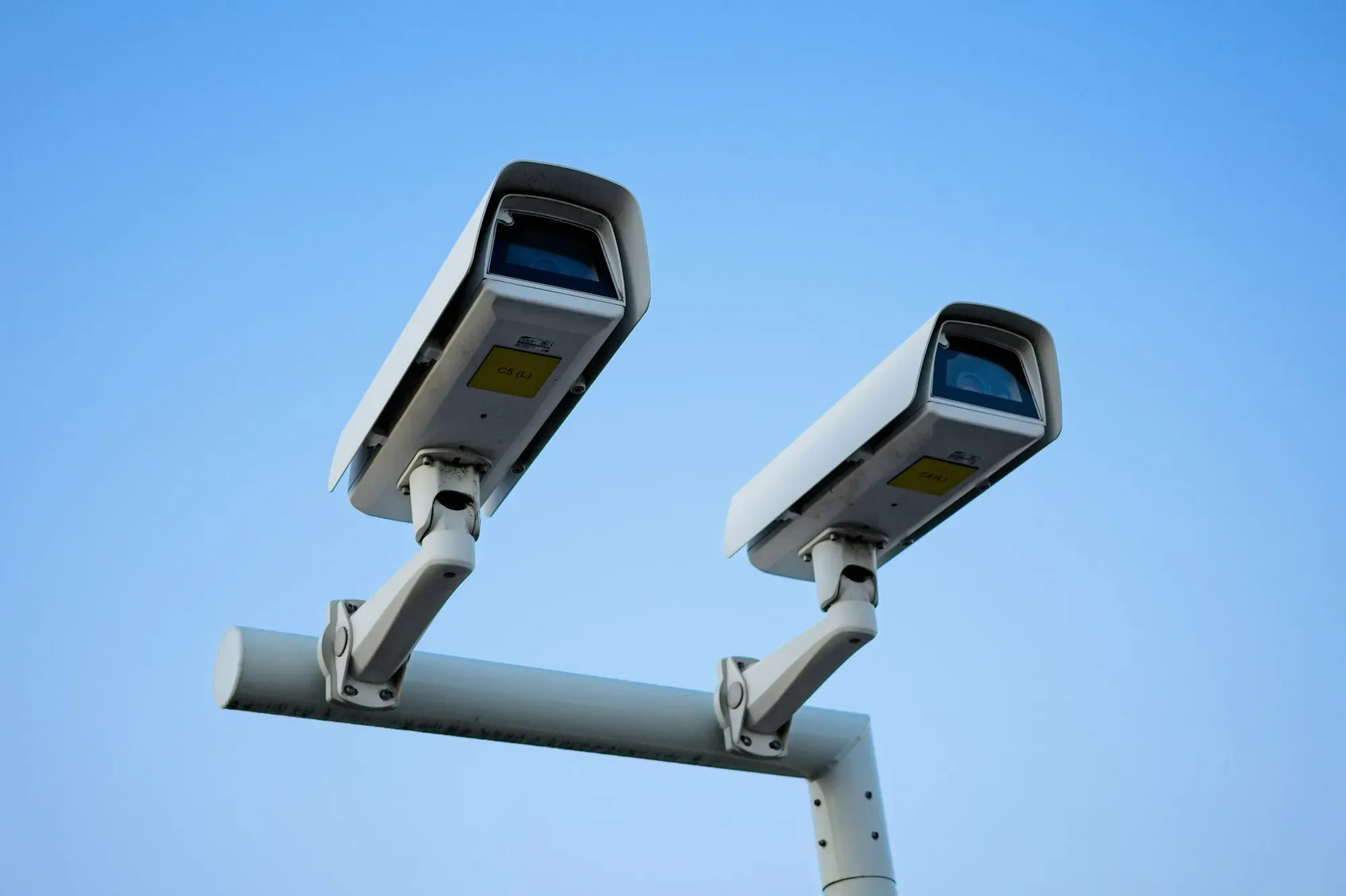
A common complaint about business CCTV concerns notifications: the manager's phone gets dozens of alerts overnight because the camera over the car park is triggered by a tree, rain and the headlights of cars on the street. After a week nobody opens them any more, including when someone really does enter the premises.
Person and vehicle detection is meant to solve exactly this problem. It will not replace a good installation design, but with a well-set frame it lets you separate relevant events from background movement.
Motion detection vs object classification in cameras
Basic motion detection reacts to a change in the image. An alert can therefore be triggered by a shadow, rain or snow, vegetation, a light reflection or an object moving outside the area of interest.
Object classification adds another layer: the system tries to assign the event to a particular type, e.g. a person or a vehicle, before applying a notification rule. It does not establish the identity of the person or the owner of the vehicle. It sorts events according to the configured classes.
This difference matters operationally. Users who receive too many irrelevant messages stop responding to the important ones as well.
What object classification adds to CCTV
Well-configured classification limits notifications to events that match the purpose of observation. The movement of a tree by the car park is then not treated the same way as a person entering a protected zone.
It also lets you filter the event list when reviewing recordings, if the specific platform has that feature. The search scope, indexing method and available classes depend on the system, so check them in the documentation, not in the marketing slogan.
Classification helps set priorities, but it does not decide whether an event is a threat. A permitted delivery and an unauthorised entry may look like the same type of vehicle to the algorithm.
Detection zones and object type in alert rules
The mere information that a person has appeared in the frame can be too broad if the camera also covers the pavement, the entrance of a neighbouring unit or part of the road. It is worth narrowing such a frame regardless of detection anyway, because CCTV should cover the company's premises or the area around them only as far as the purpose requires.
The detection zone defines where the rule applies, and the object class defines what kind of event the system should react to. Combining both filters lets you match notifications to an entrance, a gate, a storage area or another place agreed for the site.
Boundaries are not drawn on a static preview alone. Perspective, movement and changes in lighting affect the moment of detection, so the configuration is checked in typical scenarios, watching both detected and missed events.
Image quality and detection accuracy
The algorithm works on the camera image and cannot recover features that were not recorded because of a poor frame, motion blur, strong contrast or a dirty housing.
An object that is partly visible, obscured or blending into the background may be assigned incorrectly or missed. The same can happen when night lighting creates glare and an important part of the scene stays outside the usable range of the image.
Before you change sensitivity and rules, check the mounting and the scene conditions. We cover this in more detail in our post on camera image quality at night.
Classification errors and how to test for them
The detection result depends on the input footage, how the specific platform works and the configuration. The system may miss an event, assign the wrong class or report the same movement several times, so it should not be the only mechanism responsible for security.
Rules that are too broad generate noise, and rules that are too strict can hide events that matter to the company. The right configuration is a compromise confirmed by testing.
After a change to the frame, lighting, surroundings or software, run through the acceptance scenarios again. The earlier result applied to the earlier conditions.
Where image analysis takes place
Analysis can take place on the camera, on the recorder, on another local device or in an external service, depending on the platform architecture. The properties of one solution do not carry over to another, even when manufacturers use similar feature names.
Before choosing, establish where the images and metadata go, which external connections are required and who has administrative access. This information should come from the current documentation of the chosen solution and be included in the design.
An alert vs the response to an event
A person or vehicle label makes it easier to find an event, but it does not confirm intent, identity or what actually happened. The footage has to be assessed in a wider context.
Nor does a notification create a response process if nobody is responsible for receiving, verifying and escalating it. The design should state which messages are operational, who receives them and what to do when the recipient cannot check them.
Person detection, biometrics and GDPR
In its Guidelines 3/2019 on processing of personal data through video devices, the European Data Protection Board (EDPB) explains that distinguishing categories of people without uniquely identifying anyone is not processing of biometric data under Article 9 GDPR. Object type detection, that is, “person” or “vehicle”, falls into this category.
It is different with facial recognition and other functions that create biometric templates in order to recognise a specific person, e.g. when they enter the premises again. Then Article 9 GDPR on special categories of data applies. Such a function is not switched on in passing while configuring alerts. If there is an intention to use it, the technical decision should wait for a separate legal analysis.
Number plate recognition also needs a careful approach. A registration number makes it possible to identify the owner of a vehicle, so such a function goes beyond simple “vehicle” classification and requires its own assessment of purpose and scope.
Employee monitoring: the requirements of Article 22² of the Labour Code
Detection does not change the employer's basic obligations. If the cameras cover the workplace or the area around it, Article 22² of the Labour Code applies. Among other things, it provides that:
- monitoring may be introduced if it is necessary to ensure the safety of employees, protect property, control production or keep confidential information whose disclosure could harm the employer,
- as a rule, it does not cover toilets and washrooms, changing rooms, canteens, smoking rooms or premises made available to the workplace trade union,
- recordings are processed only for the purposes for which they were collected and kept for no longer than 3 months from the date of recording (longer only when they are evidence in proceedings),
- the purposes, scope and method of monitoring are set out in the collective labour agreement, the work regulations or a notice,
- employees are informed about the introduction of monitoring no later than 2 weeks before it starts, and the area is marked with visible signs no later than the day before it starts.
Alongside the Labour Code, GDPR rules apply, including the information obligations. The retention period for recordings is set according to the purpose and procedure, and 3 months is the upper limit. We go into this in more detail in our post on retention of monitoring recordings in the company.
Here we describe the technical layer and the regulations to the extent that they affect configuration. Assessing the legal basis and compliance of a specific deployment is a job for a lawyer or a data protection officer.
When simple motion detection is enough
Classification does not always deliver value in proportion to its complexity. This applies especially to controlled interiors with little background movement, where notifications are not part of the operational process.
A simpler rule is enough if the company knowingly accepts its scope, has checked the number of irrelevant events and does not need filtering by object type. A scene test decides.
How to sign off the detection configuration
- Write down the purpose of observation and the events that should trigger an alert.
- Check the zone boundaries with movement in different parts of the frame.
- Test people and vehicles in the typical working conditions of the site.
- Note significant misses and misclassifications.
- Verify how it works after a change in lighting and at night.
- Decide who receives notifications and what the response path is.
- Check permissions, the access log and where processing takes place.
- Hand over the settings and test results in the documentation.
This kind of sign-off shows whether the configuration supports the company's agreed process under tested conditions. It does not prove the algorithm is error-free.
How we design detection in CCTV
We treat detection as part of the whole environment: network, recording, access, updates, documentation and event handling. We start with the purpose and the scenes, then choose frames and zones, and confirm the available classes in the current documentation of the specific solution. We leave the legal layer to lawyers and data protection officers.
We combine detection design with camera placement and blind spot analysis, network preparation and ongoing support as part of our corporate networks.
Sources
- Act of 26 June 1974, the Labour Code, Article 22², consolidated text Journal of Laws (Dz.U.) 2025 item 277 as amended, https://isap.sejm.gov.pl/isap.nsf/DocDetails.xsp?id=WDU20250000277 (accessed 02/10/2026)
- European Data Protection Board, Guidelines 3/2019 on processing of personal data through video devices, version 2.0, 29.01.2020, https://www.edpb.europa.eu/our-work-tools/our-documents/guidelines/guidelines-32019-processing-personal-data-through-video_en (accessed 02/10/2026)
As of 2 October 2026.