

Cable routes in the office above the suspended ceiling
The space above a suspended ceiling looks like a convenient place for cables, but office cable routes laid loosely put a load on the ceiling components, make servicing harder and can clash with other installations. We describe what to agree before the ceiling is closed, how to plan dedicated support for the routes and how to tell whether the work is ready for acceptance.
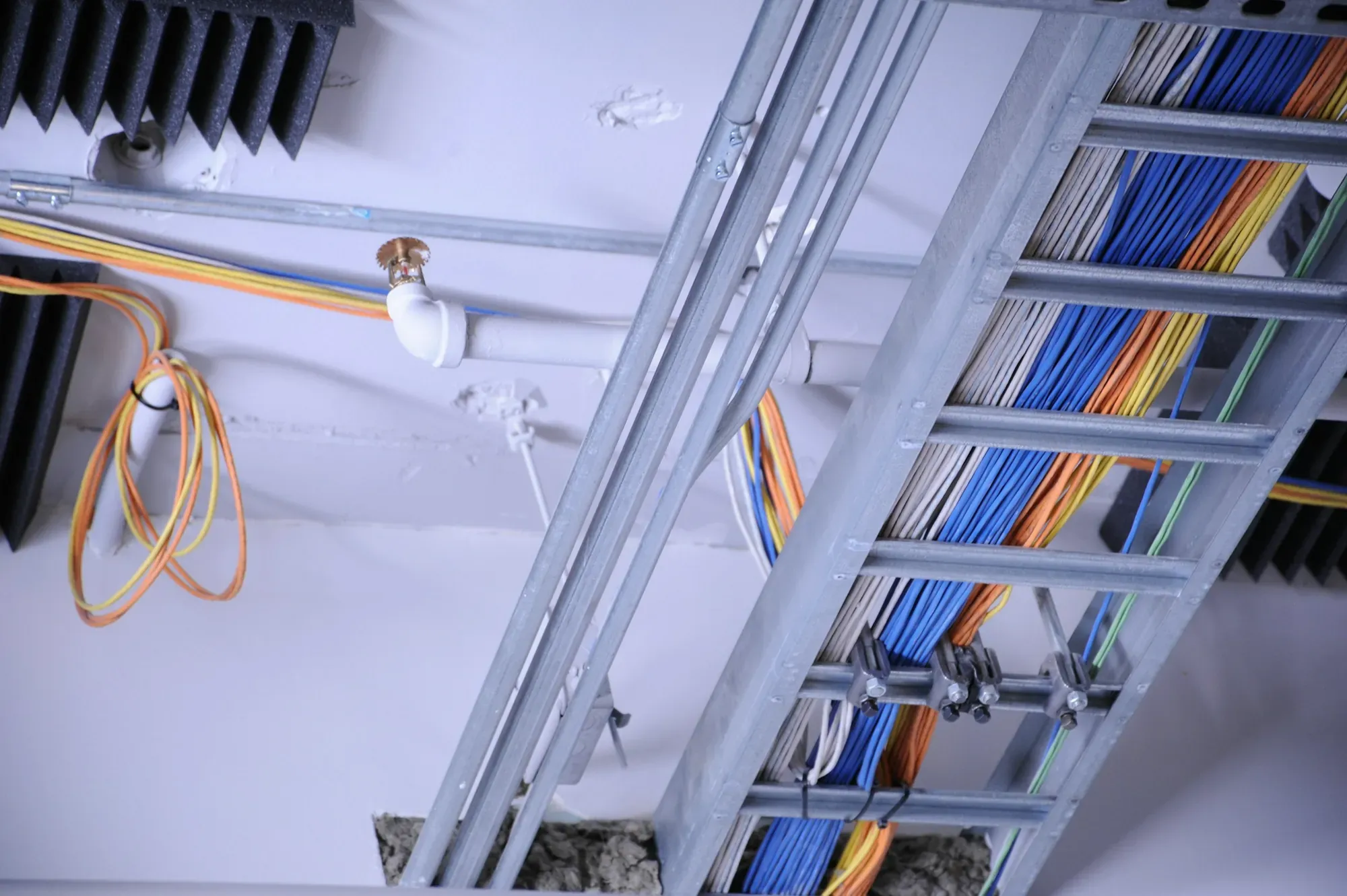
Office renovations often reveal the same picture: once a few ceiling tiles are removed, bundles of network cable lie loose on the grid, draped over light fittings and ventilation ducts. Every later change then starts with removing more tiles.
Disclaimer. The text describes the technical principles of ICT cabling and does not replace the construction, electrical or fire protection design. The method of mounting, passage through partitions and coordination with other installations must be agreed for a specific facility with the manager and persons with appropriate competences.
What is above the suspended ceiling
The suspended ceiling covers the installations, so the space above it can be easily treated as an invisible cable warehouse, although it has its own structure, limitations and tasks.
There are ventilation ducts, electrical installations, lighting, fire protection elements and other routes that require access and should not be accidentally loaded. The ceiling grid itself holds the cladding, so it should not be assumed that it can also become a support for IT cabling.
By laying cables loose on the slabs, the contractor hides the problem instead of building a route, because the cables have to be lifted, untangled and moved away during the first service, exposing them and the ceiling to damage.
Cable routes in the office need their own support
Cabling should rest on a system designed to carry it and fixed to the appropriate structural elements. The ceiling grid and hangers are not meant for this.
The type of support depends on the number of wires, route direction, load, expandability and facility conditions, because single holders will work in a different arrangement than a trough carrying multiple tracks.
When designing the fixings, you need regular support and permissible fill so that cables do not sag, are not crushed and do not transfer their weight to random points. The exact requirements should come from the documentation of the system used and the design arrangements for the building.
Coordination with other installations
The shortest path between the cabinet and the socket is not always the right one, as it may cut through access to ventilation, rest on fixtures or block elements that require later inspection.
Before starting work, it is worth comparing the routes of all industries and determining the order of execution, thanks to which each installation will maintain its own mountings and service access. Coordination is especially important when passing through walls and areas requiring re-construction, as an accidental opening may compromise a solution designed by another industry.
If documentation is missing, the first stage should be a site visit and agreement on the route, before anyone starts drilling in a place that looks convenient.
Network cables next to power cables
Network cables and power cords may appear in the same technical space, but their routing requires separation and crossing appropriate to the facility.
Long parallel runs laid without a plan increase the risk of interference, while a shared, overfilled fixing makes servicing both installations harder. When setting the route, you therefore need to know where the power cabling runs, the crossing points and the rules required by the design and the system used. The planning and installation of IT cabling inside buildings, taking into account the influence of power cabling, is covered by the PN-EN 50174-2 standard.
Also, do not assume that a cable carrying PoE power is a "meaningless" electrical cable, as the flow of current causes heating, which is exacerbated in tight bundles. The dependence of power supply on cables is described in more detail in the article about PoE power budget.
Bends, pressure and room for expansion
A cable may appear undamaged even though a sharp bend, crush or sustained stress has compromised its performance, so the routing method is as important as the cable category.
When bending, you must maintain the geometry recommended for the cable used, do not press the bundle against a sharp edge and do not clamp the fasteners tighter than required to support them. When pulling the cable, you also need to control the tension, because the finished track should rest on supports after laying, and not remain taut between points.
Future provision concerns route capacity and the ability to add cables, but should not mean loose coils thrown onto the ceiling tiles.
Service access has an impact on cost
A route that is only accessible after removing many boards and disassembling other components will be expensive in any subsequent diagnostics, even if it appeared to be the shortest during assembly.
When planning the route, it is worth using places available from passageways and agreed inspection openings, thanks to which you can check the fastenings, add a cable or locate damage without dismantling a large part of the ceiling.
It is also necessary to provide markings at branches and transitions, because when the ceiling is closed, identical beams without descriptions become difficult to distinguish.
Passages through partitions
Passing a cable through a wall or other partition does not end with making a hole, because the method of protection depends on the function of the partition and the requirements of the entire facility.
The 2002 regulation on the technical conditions that buildings must meet illustrates this well. It required installation penetrations in fire separation elements to have the fire resistance class (EI) required for those elements (§ 234), and wires and cables made of combustible materials run above a suspended ceiling used for ventilation or heating to have a covering of at least class EI 30 (§ 259(2)). According to the Internet System of Legal Acts (ISAP), this act is deemed repealed from 21 September 2026, so the requirements in force for a specific building must be confirmed in current regulations.
If the work touches such solutions, the scope, materials and documentation should be determined by people with the appropriate qualifications, for example the building designer or a fire safety expert, in agreement with the building manager. The network installer, on the other hand, should identify all penetrations, agree them before work starts and record them in the documentation, so that nobody has to search for them above a closed ceiling later.
What to check before closing the ceiling
- Whether the route has its own support independent of the ceiling structure.
- Whether the fastenings and troughs correspond to the load and the planned expansion.
- Cables are not crushed, strained or routed over sharp edges.
- Whether the agreed route for power supply and other installations has been maintained.
- Whether all partition passages have been properly agreed and described.
- Is there access to branch lines and service points?
- Whether the routes have permanent markings consistent with the documentation.
- Has each track been tested before covering.
By checking the route before closure, fixing and routing can be improved without costly dismantling, therefore acceptance of this stage should not be postponed until the end of the entire renovation.
Documentation and acceptance
As-built documentation should show the main routes, crossings, branching points, termination points and spaces left for expansion, so that the next contractor does not have to recreate the installation using a trial method.
The connection test itself only confirms the selected track property, therefore the scope of the tests must be determined before the contract and the results assigned to specific markings. What should be included in the acceptance documents is described in the article about network reception protocol.
The route should also end at an orderly distribution point, the equipment and conditions of which are described in the material about rack in a small company.
How we do it
We start with a site visit and coordination with other trades, then plan support, service access, branching and markings, without treating the ceiling as a load-bearing element for cables. We agree on the construction, electrical and fire protection scope with the people responsible for these areas, because the implementation of the network does not replace their design.
After laying the routes, we carry out acceptance before closing the ceiling, test the tracks and provide documentation, so that subsequent expansion does not start with removing slabs in search of cables.
We design and install cable routes as part of building and maintaining corporate networks, together with acceptance and documentation.
Sources
- Chancellery of the Sejm, Regulation of the Minister of Infrastructure of 12 April 2002 on the technical conditions to be met by buildings and their location (consolidated text: Journal of Laws (Dz.U.) 2022 item 1225, as amended; according to the Internet System of Legal Acts deemed repealed from 21.09.2026), § 234 and § 259, https://isap.sejm.gov.pl/isap.nsf/DocDetails.xsp?id=WDU20220001225 (accessed 02/10/2026)
- Polish Committee for Standardisation, PN-EN 50174-2:2018-08 Information technology. Cabling installation. Part 2: Installation planning and practices inside buildings, https://sklep.pkn.pl/pn-en-50174-2-2018-08e.html (accessed 02/10/2026)
As of 2 October 2026.